Imagine you're shopping for a bedside lamp. You could search Google for “blue ceramic bedside lamp” and open a few stores. Or you might ask an AI assistant, “I have a small bedroom and a narrow bedside table. What kind of lamp should I look for?”
The need is the same. The route to an answer is different.
For a business selling home décor, that difference raises an understandable question: If customers are beginning to ask AI for help, does our existing SEO work still matter?
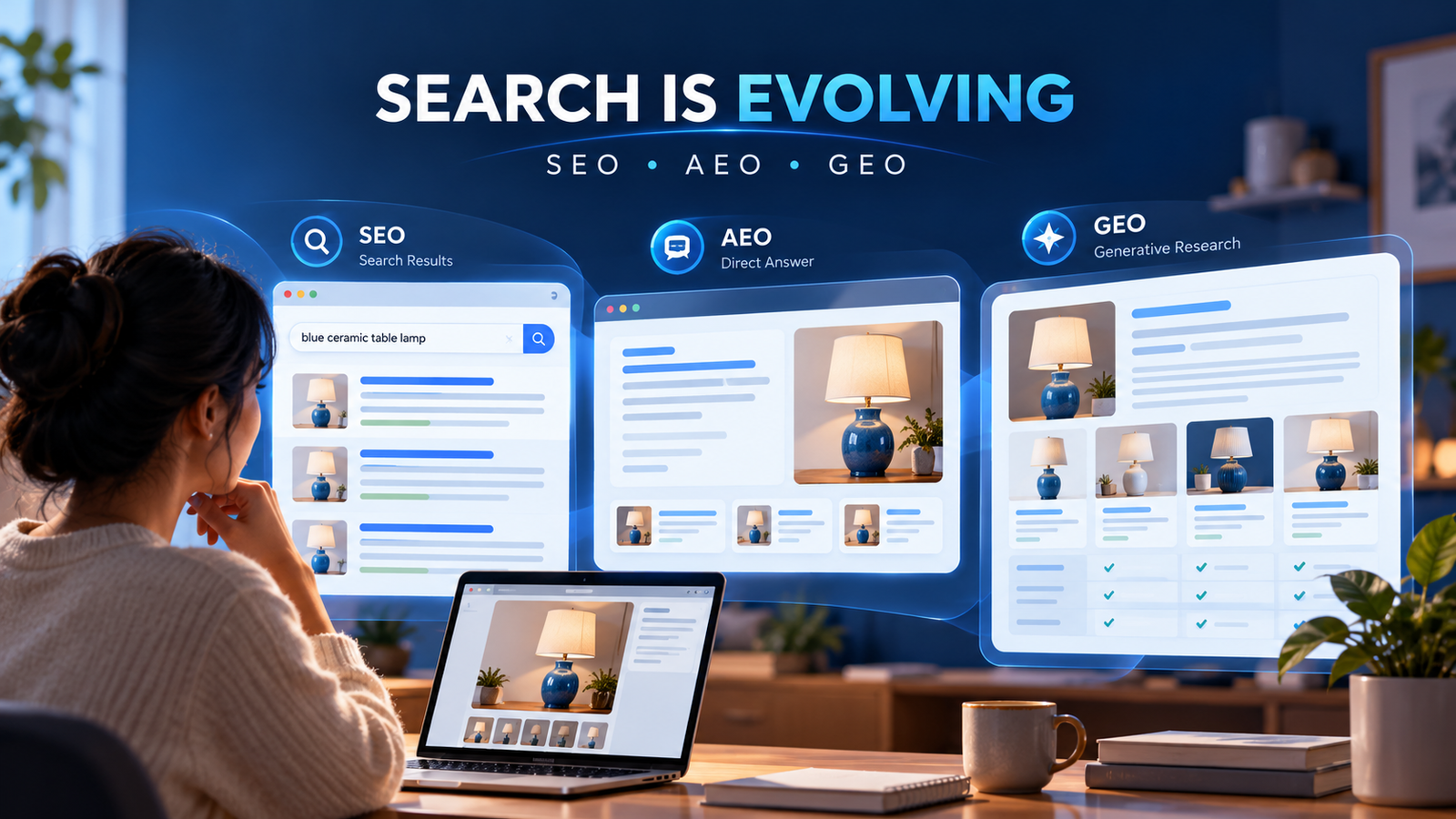
It does. But understanding why requires separating three terms that are often used as though they describe completely different systems: SEO, AEO and GEO.
First, what do SEO, AEO and GEO mean?
SEO: Helping people discover your website
Search Engine Optimization (SEO) is the work of making a website easier for search engines to understand and more useful for people who discover it through organic search.
That includes things most website owners will recognize: pages search engines can access, descriptive titles, useful content, clear navigation, sensible internal links and a website that works well on phones.
SEO doesn't guarantee a first-page result. It improves the foundations on which search visibility depends. Google's SEO Starter Guide is a useful reference for anyone starting out.
This is also why website audits are worth doing before adding more content. At Kritrim, Ullikh is our website-crawling and product-data intelligence component. Its work is relevant to identifying gaps in the information a website makes available, including structural and validation issues. It's one part of our broader approach to search readiness—not a guarantee of better rankings.
AEO: Making information useful when people ask questions
Answer Engine Optimization (AEO) is a term marketers use for improving how clearly information can answer a person's question in answer-oriented search experiences.
Those experiences can include a traditional featured snippet or an AI-assisted answer. The technologies aren't identical: a featured snippet highlights content from a page, while a generative answer may combine information from multiple sources.
Suppose a buyer asks, “What should I check before buying a bedside lamp for a small room?” A helpful page could explain dimensions, light direction, bulb compatibility and safety information rather than simply repeat “best bedside lamp” throughout the text.
That makes the page more useful to the buyer. It does not mean an answer engine must select or cite it.
For an ecommerce business, answering well often starts with knowing exactly what a product is, what its verified attributes mean, and how it relates to a customer’s need. That is the idea behind Arth, Kritrim’s semantic product-understanding component: making product information more coherent and useful across discovery experiences. It is an information-quality approach, not a way to force an AI-generated answer to mention a brand.
GEO: Considering how information appears in generative AI answers
Generative Engine Optimization (GEO) is another industry term, generally used for efforts to improve visibility or representation in AI-generated responses that draw on information from multiple sources.
A customer might ask an AI tool to compare ceramic and metal lamps, explain the trade-offs and suggest what to consider for a particular room. Where a tool uses web search, it may provide links or citations to supporting pages.
The distinction between AEO and GEO isn't universally settled. In practice, they overlap considerably. Google's 2026 guidance explicitly treats optimization for its generative Search experiences as part of SEO, not a replacement for it.
The useful way to think about the three terms: SEO helps make information findable; AEO emphasizes answering questions clearly; GEO emphasizes how information may be represented within generated answers. All three depend on having something accurate and worthwhile to say.
One customer, three discovery experiences
Consider a hypothetical store selling handmade ceramic lamps. A shopper is deciding what will work in a compact bedroom.
- In traditional search, the shopper might search for “small blue ceramic bedside lamp” and browse results. Clear photos, product details, prices and availability would help them decide which pages to open.
- In answer-oriented search, they might ask, “What size lamp works on a narrow bedside table?” Here, practical dimensions, placement guidance and an honest explanation matter more than repeating a product name.
- In generative AI-assisted research, they might ask, “Compare ceramic and metal bedside lamps for a small room.” Useful sources would explain verifiable characteristics, differences and trade-offs—not just declare one option the winner.
These are illustrative customer questions, not actual search results or predictions of which sites an AI system will show.
A good product page can serve all three situations. It doesn't need three separate versions written for three different acronyms.
The real problem appears when a business has a product online but provides too little information for anyone to judge whether it is suitable.
“Elegant premium lamp for every home” sounds pleasant. But it doesn't answer whether the lamp will fit on a 30-centimetre-wide table, which bulb it accepts, or whether the bulb is included. Those facts should be published only after the seller has verified them.
Clear information helps a customer decide even when no search engine or AI assistant sends the customer to the website.
So what's actually changing in search?
People can ask a full question instead of only entering keywords
A short search such as “ceramic lamp” is still useful. But conversational interfaces also let people describe a situation, set constraints and ask follow-up questions.
For businesses, that means a page should go beyond naming a product or service. It should explain who it is suitable for, how it works, and when a different option might be better.
Some answers are assembled before a customer visits a website
Google's AI Overviews and AI Mode can show AI-generated responses with links to supporting web pages. Google says these experiences can use several related searches to address a question. Its explanation of AI features describes how this works at a high level.
ChatGPT Search can also provide web-based answers with citations. OpenAI's search guidance explains how people can review the sources behind a response.
These experiences don't always show the same sources, and they don't replace ordinary search results in every situation. Being eligible to appear is not the same as being selected.
Visibility and website visits are no longer the same question
A business might appear in a search result, be linked from an AI-generated answer, or be mentioned in a response without receiving a visit. Those are different outcomes.
That is why “Are we ranking?” is no longer the only question worth asking. Businesses should also consider whether their information is accurate, whether customers can find the detail they need, and whether discovery leads to useful enquiries or purchases.
What should a business do first?
You don't need to rebuild your website around an acronym. Start with improvements that are useful regardless of where customers discover you.
1. Make important pages accessible. Check whether your key pages can be found and indexed in search. Review your site's configuration and use Google Search Console to investigate problems. For other search experiences, crawler rules and eligibility may differ, so check the documentation for each platform.
2. Answer questions your customers really ask. Review product enquiries, customer support conversations and sales discussions. If people repeatedly ask whether a product is suitable for a particular use, answer that question clearly on the relevant page.
3. Replace vague claims with verified detail. Materials, sizes, compatibility, delivery conditions, care instructions and return policies can be more helpful than repeated superlatives. Don't invent information to make a listing look complete.
4. Give readers a reason to trust what they find. Original photographs, first-hand experience, accurate product specifications and transparent limitations help people assess a claim. A thoughtful comparison that includes disadvantages can be more useful than one that declares everything “the best.”
5. Connect related pages naturally. Someone reading about a lamp may need the product specifications, care instructions or shipping policy next. Make those pages easy to reach with descriptive internal links. Write for the person navigating the site, not for a supposed AI-only format.
6. Measure what matters to the business. Search visibility, AI-related impressions where reporting is available, referral visits and eventual enquiries or sales answer different questions. Track them separately rather than assuming a citation equals a customer.
What about AI SEO shortcuts?
It's sensible to be cautious about promises such as “Add this file and ChatGPT will recommend your business” or “Use this schema to rank in AI Overviews.”
Google says there is no special schema markup required to appear in its AI Overviews or AI Mode, and that llms.txt is not used by Google Search as a special visibility signal. Structured data can still be valuable for the existing search features that support it. The practical lesson is to follow each platform's published guidance rather than assume one technique works everywhere.
It is also worth resisting the urge to publish dozens of near-identical pages for every possible question. A small number of genuinely helpful pages is a better place to begin than a large collection of content that says very little.
The same caution applies to guarantees. Google does not promise indexing or visibility simply because a site follows best practices. OpenAI likewise notes that placement in ChatGPT Search is not guaranteed.
A simple exercise you can do this week
Choose one important product or service page on your website. Then ask:
- Can someone quickly understand what we offer and who it is for?
- Have we answered the two or three questions customers ask before buying?
- Are the facts correct, current and consistent with our other pages?
- Can a visitor easily find supporting information or contact us?
- Would the page still be genuinely useful if no AI system ever cited it?
If several answers are “no,” you have a practical starting point. Improve that page first, then check how customers respond.
The point isn't to chase another acronym
The way people discover businesses is changing, but their underlying need hasn't: they want information they can understand and trust before making a decision.
SEO continues to matter. AEO and GEO are useful ways to discuss new answer-oriented experiences, provided we don't mistake the terminology for a guaranteed growth formula.
At Kritrim System, we believe the more useful question is not “How do we make AI mention us?” but “Have we made our business information clear enough to be genuinely helpful?”
That's work worth doing whether someone finds you through a search result, an AI-generated answer or a recommendation from another person.
For businesses working through these questions, Kritrim System brings together complementary areas of work: Ullikh focuses on website and product-data discovery and validation, while Arth focuses on the meaning and relationships within product information. Both belong to a broader effort to make business information more useful to people and the systems they rely on. You can also explore more practical technology perspectives on the Kritrim blog.